
A Beginner’s Guide to the IEP Process: What Every Parent Should Know
If your child has special needs, you’ve probably heard the term IEP. At first, those three letters can feel overwhelming, mysterious, or even a little scary but an IEP, short for Individualized Education Program, is simply a plan designed to help your child succeed in school.
If this is your first time navigating the IEP process, you may be wondering: What exactly happens? Who will be involved? How do I make sure my child’s needs are met? This guide will walk you through key aspects of the process, give you a sense of what to expect, and share tips on how to advocate for your child along the way.
What Is an IEP?
An IEP is a legal document that outlines your child’s learning needs, the services the school will provide, and the goals your child is working toward. It is part of the Individuals with Disabilities Education Act (IDEA), a federal law that ensures students with disabilities receive the support they need.
Think of the IEP as a roadmap. It guides teachers, therapists, and other school staff so that your child can make progress in school – not just academically, but socially, emotionally, and behaviorally too.
Who Qualifies for an IEP?
Not every child needs or qualifies for an IEP. To be eligible, a child must have a disability that affects their ability to learn in a general education setting. Disabilities can include autism, speech and language impairments, ADHD, learning disabilities, developmental delays, emotional or behavioral challenges, and more.
It’s also helpful to note that an IEP is different from a 504 Plan, which provides accommodations (like extended test time or preferential seating) but not specialized instruction. An IEP goes further, providing both accommodations and direct special education services when needed.
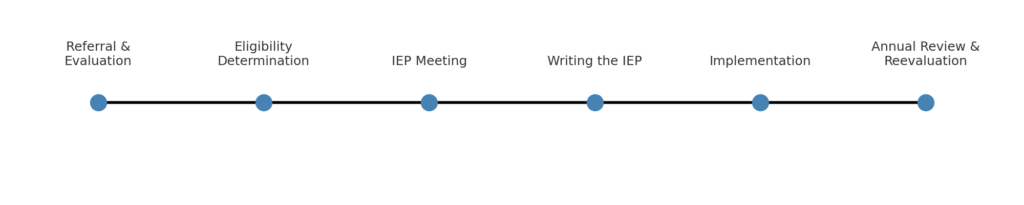
The IEP Process: Step by Step
- Referral and Evaluation: The process begins when someone (either a parent, teacher, or specialist) raises concerns about a child’s learning or development. This is most often in the form of a written request for evaluation to the school. From there, the school conducts various assessments. These may include academic tests, speech and language evaluations, occupational or physical therapy assessments, behavioral observations, or psychological testing. Regardless of who makes the request, parents must give consent before evaluations can take place.
- Eligibility Determination: Once evaluations are complete, a team (including parents) reviews the results. Together, you’ll determine if your child qualifies for an IEP under one of the 13 disability categories outlined in IDEA.
- The IEP Meeting: If your child qualifies, the school will schedule an IEP meeting. This is where the plan is created. People at the meeting may include:
- You (the parent or guardian)
- Your child’s general education teacher
- A special education teacher
- A school administrator
- Specialists who evaluated your child (such as a speech therapist or psychologist)
- Sometimes, the student (especially as they get older)
- Writing the IEP: The IEP will include:
- Present Levels of Performance (PLOP): A snapshot of your child’s current strengths and challenges.
- Measurable Annual Goals: Specific skills your child should work toward over the next year.
- Services and Supports: These could include therapies (speech, occupational, physical), specialized instruction, or classroom accommodations.
- Placement: Where your child will learn. The goal should be to have your child in the least-restrictive environment, alongside peers, as much as possible.
- Progress Monitoring: How the school will track and report your child’s growth.
- Implementation: Once the IEP is finalized, teachers and staff will begin putting it into action. You should receive updates on your child’s progress regularly, often quarterly, alongside report cards.
- Annual Review and Re-evaluation: The IEP team meets at least once a year to review and update the plan. Every three years, a re-evaluation helps determine whether your child still qualifies and any changes may be needed.
What to Expect During an IEP Meeting
If this is your first IEP meeting, it may feel intimidating. You’ll likely be seated at a big table with several school staff members, or you may be joining a virtual meeting with many others attending. You may hear lots of educational jargon. Remember: you are an equal member of the team.
Here are some things to expect:
- Meetings can be paperwork-heavy. Don’t hesitate to pause and ask questions.
- You’ll likely be asked to share your perspective on your child’s strengths and needs. If you are not asked, ensure you ask to be heard.
- Teachers and specialists will review their evaluation results.
- Together, you’ll set goals and decide what services your child will receive.
Tip: Bring a notebook with your questions and concerns. You can also bring a trusted friend, family member, or advocate for support.
The Importance of Advocacy
No one knows your child better than you do. That’s why your role as an advocate is so important. Advocacy doesn’t mean being confrontational, it means making sure your child’s voice is heard and their needs are met.
Ways to advocate effectively:
- Ask for clarification – If you don’t understand something, ask at the meeting for clarification.
- Take your time – You don’t have to sign the IEP right away; you can request time to review it.
- Stay involved – Follow up on progress reports and communicate with teachers regularly.
- Know your rights – Parents have the right to request meetings at any time, disagree with parts of the IEP, and pursue mediation or due process if necessary.
Common Concerns Families Have
- “I’m overwhelmed by all these terms and acronyms.”
It’s okay to ask the school team to explain things in plain language. No one expects you to be fluent in “education speak.” - “I don’t want to fight with the school or cause too much trouble.”
Remember, you and the school are partners. Most teams want the same thing you do: your child’s success. Still, it’s okay to respectfully push back if something doesn’t feel right. - “I’m worried my child will be labeled.”
An IEP isn’t a label, it’s a tool! It ensures your child gets access to resources and strategies that can help them thrive. - “What if the IEP doesn’t seem to be helping?”
You don’t have to wait for the annual meeting to make changes. Parents can request an IEP meeting at any time to review concerns.
Final Thoughts and Resources
The IEP process may feel like a lot to take in, especially at first, but remember, each step is designed to create a support system tailored to your child’s unique needs. With time, the meetings and paperwork will feel less daunting and you’ll gain confidence in speaking up for your child.
Your voice matters. When families, teachers, and specialists work together, children are given the best chance to reach their full potential.
If you’d like to learn more or connect with support, here are some helpful resources:
- Understood.org Parent-friendly resources on IEPs and learning differences
- Wrightslaw Information on special education law and advocacy
- Local parent advocacy groups or special education resource centers in your community
You and your child are not on this journey alone, and with an IEP in place, you’re taking a big step toward helping them succeed.